Once located where the Bell Telephone Company currently stands, the Judd-White house was home to young married couple Warren and Vashti Rowland. Having married in 1907, their tragic story in Grand Rapids began when Warren started a job at G.R. and Indiana Railroad, where he lost his leg in a gruesome railroad accident. After Warren’s accident, he was fitted with a wooden leg, a piece of him that would later contribute to the couple’s tragic end.
As the
Grand Rapid Press of July 10, 1909 (pictured at right) reports, those who knew the couple said that Warren and Vashti never appeared to be happy with each other. Vashti’s sister expressed a long-held fear that Warren would murder her sister, recalling once seeing Warren chase Vashti down the street with a razor. After months of the couple living unhappily together, the two separated, leaving their residence at the Judd-White house vacant. This would be the last time the room would have any peace.
A short time after the couple separated, Warren called upon Vashti, presumably to make peace with his estranged wife. But the opposite came true.
As Warren and Vashti made their way into their former home, Warren removed his wooden leg and beat Vashti over the head. As Vashti was lying on the floor, unconscious, Warren locked the door to the room and began to seal the windows with towels to close any gaps to make the room airtight. He then went to the gas fixture on the wall and began to fill the room with a noxious gas. Warren, however, was not finished with his task. Using a razor, he attempted to kill himself.
When their bodies were discovered two weeks later, reports show that Warren had not cut himself badly enough to kill himself, and instead most likely passed from the fumes. After hearing of the tragic story, locals speculated that Warren was a mad man who became angry and jealous after believing his wife was seeing someone else. The public maintained this opinion. According to the
Grand Rapids Press article, “No note of farewell to the world was found in the room, nor any clue regarding the motive of the crime.”
After their death, the room remained vacant for some time, with no one wanting to stay there due to its horrid past. In 1920, the Judd-White house was torn down, and in its place stands the Michigan Bell Telephone Company building. Although the house is gone, people claim that the spirits of Warren and Vashti Rowland are still there today.
**********
Among the repertoire of haunted places, mental asylums are infamous for being severely haunted by former patients and staff who lived within their walls. In Michigan, Traverse City State Hospital is one of these abandoned places, with a history of suffering and horror that has outlived the hospital itself.
In 1885, Traverse City State Hospital was opened and remained so for a little over a century before it was closed and abandoned.
 |
| Northern Michigan Asylum Report, 1908 |
The stigma of mental health remains an obstacle even now, as it was during the 19th century, when mental hospitals were still in their infancy in the U.S. Although these hospitals aimed for the greater good, many patients suffered cruelty at the hands of doctors and staff who ran these institutions. The practice of lobotomy, the use of straight jackets, and periods of isolation were common in mental hospitals, with the belief that they would help the patient. However, thanks to our better understanding of modern psychology, it is now known these practices created more harm than good.
As the years passed and the state hospital became more decrepit, the building became a spot for vandals and those curious to explore. From these visits come the stories of the ghosts who haunt the building. It is reported that individuals have seen faces appear through windows, radios emit nothing but static, or people sense the feeling of someone lurking. Many patient deaths occurred at the hospital, with the common forms of death being disease and suicide.
Throughout the years, horror stories of the abandoned hospital have emerged. An internet urban legend tells of the story of two young boys who were patients at the hospital and how one disappeared.
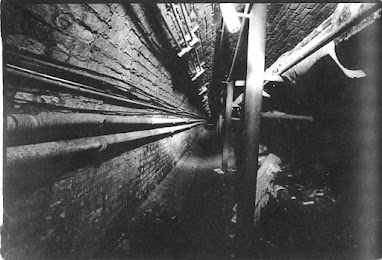 |
| Northern Michigan Asylum Tunnels |
The two boys were outside playing and had begun to wander. As their trek across the grounds continued, they ventured into the underground tunnels that traveled beneath the buildings. As they continued to walk down the tunnels, they encountered a man who was an escaped patient of the hospital and had been living in the tunnels ever since his escape. Terrified of the man, the boys ran out of the tunnels, but sadly only one would make it out. Having run for some time, one of the boys looked behind for his friend, but he was nowhere to be seen. After reporting the incident to the hospital staff, they searched for the missing boy but could find no trace of him other than his St. Raphael necklace. Over a month later, the boy’s remains were found at what now is known as the hippie tree–a name created from the delinquent activities that took place there.
 |
Northern Michigan Asylum Report, 1908
(click to enlarge) |
While this urban legend does not give the time of this incident, looking into a report from the Board of Trustees of Traverse City State Hospital, fourteen men were discharged from the hospital in an unimproved mental state in 1908. Earlier in the report, it is also stated that of 505 patients admitted, “15 were homicidal or had threatened homicidal assaults.” Is it possible that one of the men discharged was also the murderous man in the tunnel? While legend says he escaped, is it possible that he could have taken refuge in the tunnels after being discharged?
**********
Before even the nation’s first mental hospital opened its doors, and before Michigan became an official state, the territory in the Great Lakes region saw both violence and sweeping changes. Like with the case of Warren and Vashti Rowland and the chilling conditions of Michigan’s mental asylums, colonization and the conflicts between settlers and Indigenous peoples are remembered not just through history books, but through hauntings.
From the book,
Haunted Houses of Grand Rapids, comes the tale of Big John, an Ottawa fur trapper from the 1850s. In 1936, Grand Rapids homeowners Lillian and Tom Rush encountered a ghostly figure in their basement. While firing guns at their in-home firing range, Lillian saw a man emerge from the furnace, “tall and somber, with a high-crown hat of the type worn by bad men in old western movies” (p. 11-12). Wearing two long black braids and a watch chain, the specter of Big John stood silently in their basement before disappearing as abruptly as he had appeared.
Big John’s apparition was a remnant of the Michigan fur trade. He once lived in a wooden house located where Lillian and Tom’s abode later stood, where he trapped beavers, mink, lynx, wolves, and bears alongside his wife and two sons. In 1857, Big John’s family was rumored to have fought over the furs, a fight that ended in John’s mysterious disappearance. While his body was never found, people of Grand Rapids believe he haunts the area to this day.
 |
| Aerial View of Grand Rapids, circa 1910 |
Murder-suicides, asylums, disappearances, and apparitions—Michigan has countless chilling tales to offer this October. But its ghost stories also get at something deeper than just raising goosebumps. Our ghost stories serve as ways of trying to understand our struggles through history. Beneath the spectacle of many of these stories lies real lives: women facing violence like Vashti, Michiganders struggling with stigma surrounding mental health before modern psychology, and the bloody history of colonization.
Don Farrant and Gary Eberle, Haunted Houses of Grand Rapids: chilling, authentic local ghost stories .... Ada, Mich.: Ivystone Publications. ca. 1979-82.
Northern Michigan Asylum,
Report of the Board of Trustees." Lansing, Michigan: Wynkoop Hallenbeck Crawford Company, State Printers. 1908.
"Used Wooden Leg To Stun His Wife," Grand Rapids Press. Grand Rapids, Michigan. July 10, 1909.