Showing posts with label Walloon Lake. Show all posts

Thursday, July 7, 2022

Abundant Waters Digital Exhibit Now Online

by Sara Daniels

3D view of the Clarke's "Fur, Freighters, Fuels" section of the exhibit

The Clarke Historical Library officially opened its most recent exhibit,
Sunset at CMU Biological Station,
Beaver Island
Abundant Waters: Our Most Precious Resource
on February 22, 2022. Now, we are proudly presenting the exhibit's digital companion. Exploring the state's cultural, environmental, political, and economic history through its 3,200 miles of freshwater coastline and 76,000 miles of rivers, this website offers new ways to approach the exhibit's driving question: how often do we actually think about our relationship with Michigan's most precious resource? 

Home to over 20% of the world's surface freshwater supply, Michigan is a state surrounded by, defined by, and embroiled in issues of water. The digital exhibit of Abundant Waters delves into the depths of Michigan's past in order to uncover our lasting connections with water and reveal how our future and the future of Michigan’s lakes and rivers are one in the same.

The digital exhibit is a culmination of months of research and community efforts. With contributions from WCMU Public Media, CMU professors and students, and members of the Saginaw Chippewa Tribal Conservation Community, the exhibit approaches Michigan's waterways through a multitude of perspectives. It provides an engaging and multidimensional platform on which to experience for yourself Michigan's greatest resource—water. From a 3D perspective of the Clarke’s physical Abundant Waters exhibit to a series of videos exploring the conservation of Michigan’s waters, the digital exhibit contains a number of fresh features and new approaches to exploring this topic and showcasing the many ways humans have interacted with and been affected by water.


Ernest Hemingway canoeing in northern Michigan


Take, for instance, one of Michigan's flashier roles as a rum-running capital, with 75% of the alcohol smuggled into the United States during Prohibition passing through one of Michigan's water borders with Canada. Or consider Michigan's status as the “Arsenal of Democracy” during World War II—it went beyond building bombers, with one of Michigan’s own Chris-Craft ships among the first to make landfall in Normandy on D-Day.
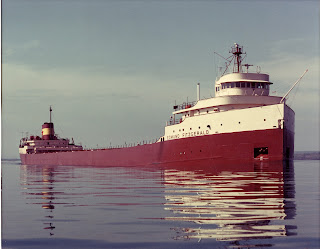
Michigan's waters have occupied countless other roles in personal, state, and national histories, which the Clarke explores in its digital exhibit. Its Great Lakes have been a 
The Edmund Fitzgerald
graveyard to hundreds of ships
; its northern freshwater springs have been touted as miracle healers. Its ports and straits have acted as home to both war and industry, while its waters hold a sacred, life-giving status for Indigenous communities. 

To the famous American novelist Ernest Hemingway, Michigan was "a great place to laze around and swim and fish when you want to. And the best place in the world to do nothing." To others, it’s the best place in the world to do something—for the Soo Locks, that’s 80 million tons of commodities navigating the St. Mary’s falls each year. For each of the hundreds of millions of others to come in contact with Michigan, its waters represent something unique and personal.

Abundant Waters taps into this complex tapestry, illuminating the webs of connection flowing through Michigan's waterways and tying together facets of history and human experience. The exhibit aims to help the public reflect on our complex and meaningful relationships with water and to help us understand how water connects us all across time and space. 

Canoe manifest bound for Drummond Island c. 1818

Ultimately, Abundant Waters explores the lakes and rivers of Michigan as cultural, spiritual, and commercial epicenters, ones that define and sustain the region physically, ecologically, and economically. It imagines water in its many forms—mover of industry, mode of exploration, borderlands between/hubs within nations and peoples, and carrier of story—and in its ultimate form, as the veins that carry the lives of not just Michiganders, but people everywhere. Visit the digital exhibit today, with its new features and extended access to photographs and primary documents, to discover for yourself how we see ourselves—and each other—in Michigan's great waters.

The Abundant Waters exhibit is funded, in part, by an award from the American Library Association as part of the ALA’s American Rescue Plan: Humanities Grants for Libraries program.

3D view of the Clarke's "Disasters" section of the exhibit

Tuesday, February 22, 2011

Picturing Hemingway's Michigan

By Frank Boles

(to see a podcast of this February 16, 2011 presentation at ITunes U, click here)

Michael Federspiel, author of Picturing Hemingway’s Michigan (Detroit: Wayne State University Press, 2010) spoke at the Library on February 16. Mike offered an interesting, nuanced, and informative presentation that looked at three questions:
  • What was Petoskey like at the beginning of the 20th Century?
  • How did the Hemingway family compare to the many other “summer people” who came to northern Michigan “for the season?”
  • How did northern Michigan influence Ernest Hemingway’s fiction?
Petoskey, in 1873, was little more than a point on a map. Two European families had settled in the area. There were no hotels, no railroad connections, and most importantly no tourists. By the beginning of the 20th Century, the community had radically changed. It was home to 6,000 permanent residents. Another 25,000 or so individuals spent the summer in or near the community. In addition a vast number of “day visitors” came to the town. By one estimate in 1908, 128,000 day visitors came to Petoskey.

A vast infra-structure of trains and ships brought these visitors to the community. In 1906 13,000 trains arrived in Petoskey between June 25 and September 30, averaging an amazing 124 trains per day, or put another way, one train every 5 minutes. To house these many visitors, fourteen hotels offered 2,000 rooms for rent each night.

Petoskey had become a major tourist destination. Among those who came regularly to partake in its attractions were the Hemingways. They had built a cottage on Walloon Lake in 1899. Each year the family traveled from their home in suburban Chicago to spend the summer on the lake. How they spent their time during the summer would resonate with anyone who goes “up north” today. They spent time outdoors.  They regularly swam in the lake. Hunting, and in particular fishing, were regular activities. On rainy days they read books. Every now and again they traveled “to town” for “supplies.”

What is most notable, Mike pointed out, is how typical the family was. Biographers of Ernest Hemingway sometimes strain to find that moment when the young Ernest Hemingway revealed himself to be the great writer he would become. The truth is there was no such moment. The Ernest Hemingway who spent his summers at a cottage on Walloon Lake was a typical child. He was not “Ernest Hemingway, writer of great promise.” He was simply, “the Hemingway’s boy” doing what boys do during the summer.

Yet something about those years “up north” never left Hemingway. Late in his life he wrote a reminiscence about the years he spent as a young writer in Paris, where his fame as a writer first emerged. Eventually published as A Moveable Feast, in it Hemingway wrote:

“I sat in a corner [of a Parisian café] with the afternoon light coming in over my shoulder and wrote in the notebook.  The waiter brought me a café crème and I drank half of it when it cooled and left it on the table when I wrote.  When I stopped writing I did not want to leave the river where I could see in the pool, its surface pushing and swelling against the resistance of the log driven piles of the bridge. The story was about coming back from the war but there was no mention of the war in it.  But in the morning the river would be there and I must make it and the country and all that would happen. ”

The bridge he recalled so vividly was almost certainly in Seney where he began a fishing trip with two friends in August 1919. In many ways the trip to Seney and beyond was an important one for the young Ernest. Hemingway had returned from World War I slowly recovering from physical injuries. After his arrival at his parent’s home in suburban Chicago, he suffered a perhaps even more devastating emotionally loss when the woman he thought would marry him ended their relationship. In the 1920s, while living in Paris, Hemingway would transform his fishing trip to Seney and beyond into the story, “The Big Two Hearted River,” a story of a young man suffering in ways not well defined and seeking solace in nature. Near the end of Hemingway’s life, when reflecting upon what he had done during those years in Paris, that trip to Seney, that bridge, the rivers he fished while in the Upper Peninsula, and the emotions that played across his heart and his mind during that difficult summer, were still vivid in his imagination.

As Mike Federspiel concluded, trying to explain how Hemingway used his Michigan experiences to create world-renowned fiction requires and explanation of genius. It is something those who lack that genius likely cannot do. But it is perhaps enough to recognize that somehow “the Hemingway’s boy” used his inexplicable gifts to reimagine in words of beauty and power much of what had happened and much of what he had felt during his many years in Michigan. The stories that resulted created memorable fiction as well indelible images of summer “up north.”

It was a wonderful evening that the audience greatly enjoyed and from which they greatly profited. The Library was very pleased to have been able to make the event possible.