Showing posts with label World War II. Show all posts

Thursday, July 7, 2022

Abundant Waters Digital Exhibit Now Online

by Sara Daniels

3D view of the Clarke's "Fur, Freighters, Fuels" section of the exhibit

The Clarke Historical Library officially opened its most recent exhibit,
Sunset at CMU Biological Station,
Beaver Island
Abundant Waters: Our Most Precious Resource
on February 22, 2022. Now, we are proudly presenting the exhibit's digital companion. Exploring the state's cultural, environmental, political, and economic history through its 3,200 miles of freshwater coastline and 76,000 miles of rivers, this website offers new ways to approach the exhibit's driving question: how often do we actually think about our relationship with Michigan's most precious resource? 

Home to over 20% of the world's surface freshwater supply, Michigan is a state surrounded by, defined by, and embroiled in issues of water. The digital exhibit of Abundant Waters delves into the depths of Michigan's past in order to uncover our lasting connections with water and reveal how our future and the future of Michigan’s lakes and rivers are one in the same.

The digital exhibit is a culmination of months of research and community efforts. With contributions from WCMU Public Media, CMU professors and students, and members of the Saginaw Chippewa Tribal Conservation Community, the exhibit approaches Michigan's waterways through a multitude of perspectives. It provides an engaging and multidimensional platform on which to experience for yourself Michigan's greatest resource—water. From a 3D perspective of the Clarke’s physical Abundant Waters exhibit to a series of videos exploring the conservation of Michigan’s waters, the digital exhibit contains a number of fresh features and new approaches to exploring this topic and showcasing the many ways humans have interacted with and been affected by water.


Ernest Hemingway canoeing in northern Michigan


Take, for instance, one of Michigan's flashier roles as a rum-running capital, with 75% of the alcohol smuggled into the United States during Prohibition passing through one of Michigan's water borders with Canada. Or consider Michigan's status as the “Arsenal of Democracy” during World War II—it went beyond building bombers, with one of Michigan’s own Chris-Craft ships among the first to make landfall in Normandy on D-Day.
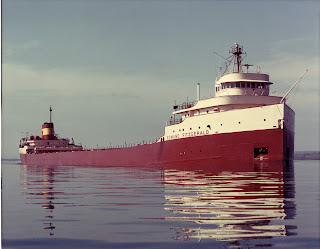
Michigan's waters have occupied countless other roles in personal, state, and national histories, which the Clarke explores in its digital exhibit. Its Great Lakes have been a 
The Edmund Fitzgerald
graveyard to hundreds of ships
; its northern freshwater springs have been touted as miracle healers. Its ports and straits have acted as home to both war and industry, while its waters hold a sacred, life-giving status for Indigenous communities

To the famous American novelist Ernest Hemingway, Michigan was "a great place to laze around and swim and fish when you want to. And the best place in the world to do nothing." To others, it’s the best place in the world to do something—for the Soo Locks, that’s 80 million tons of commodities navigating the St. Mary’s falls each year. For each of the hundreds of millions of others to come in contact with Michigan, its waters represent something unique and personal.

Abundant Waters taps into this complex tapestry, illuminating the webs of connection flowing through Michigan's waterways and tying together facets of history and human experience. The exhibit aims to help the public reflect on our complex and meaningful relationships with water and to help us understand how water connects us all across time and space. 

Canoe manifest bound for Drummond Island c. 1818

Ultimately, Abundant Waters explores the lakes and rivers of Michigan as cultural, spiritual, and commercial epicenters, ones that define and sustain the region physically, ecologically, and economically. It imagines water in its many forms—mover of industry, mode of exploration, borderlands between/hubs within nations and peoples, and carrier of story—and in its ultimate form, as the veins that carry the lives of not just Michiganders, but people everywhere. Visit the digital exhibit today, with its new features and extended access to photographs and primary documents, to discover for yourself how we see ourselves—and each other—in Michigan's great waters.

The Abundant Waters exhibit is funded, in part, by an award from the American Library Association as part of the ALA’s American Rescue Plan: Humanities Grants for Libraries program.

3D view of the Clarke's "Disasters" section of the exhibit

Wednesday, December 7, 2016

Central Michigan College of Education and Pearl Harbor

by Bryan Whitledge

Today marks the 75th anniversary of, as then-President Franklin D. Roosevelt said, "a date which will live in infamy." The attack on Pearl Harbor sent shock waves across the whole of the United States including at Central Michigan College of Education in Mount Pleasant, Michigan.

The most direct connections between Central and the Pearl Harbor attack were two former students who were stationed at the Hawaiian naval base on December 7, 1941. Harry Schmidt (pictured at left, from the 1940 yearbook) was aboard the USS Tennessee. He survived the attacks and continued to serve in the Navy through at least the fall of 1943. In 1939-40, he was a freshman and played saxophone with Howdy Max's Band.

Another former student, William Kyes (pictured below, from the 1940 yearbook), was an officer in the Army Air Corps and also survived the attacks. When the bombing started, he ran into a nearby hangar, which was then hit. John Cumming's The First Hundred Years: A Portrait of Central Michigan University included then-Lt. Kyes account from a letter:

"I looked over by a wall and there was a man holding his guts in and another with his face shot off. I began to wonder if I was hit and when I looked myself over, there was a piece of my chest gone and blood running out of my ankle but I felt no pain."

Lt. Kyes also noted in a letter that if he ever made it through the War, he would get a job at a country school by Elwell and settle down for the rest of his life. Those plans didn't come to pass. Instead, Lt. Kyes served for the duration of the War and flew over 50 bombing missions in the Pacific Theater. He was a career military officer and retired in 1969 with the rank of Brigadier General in the Air Force.

Back in Mount Pleasant, 4,400 miles from the two Centralites stationed at Pearl Harbor, the students at the College wanted to join in the war effort. Some students expressed a desire to enlist with the military as soon as possible, but President Anspach, a member of the local draft board, urged young men to stay in school and gain knowledge and experience for the time when Uncle Sam would call on them. By June 1942, just six months after the attack, it was reported that 150 former Central students had joined the armed forces.

In the days immediately following the attack, students also mobilized to help with a Red Cross emergency fund drive. All students and faculty were expected to contribute and women members of the Appleblossom Club, a club that advocated for improved rural education, dressed as Red Cross nurses to solicit donations from across campus. The Women's League at Central organized a knitting bee on January 5, where the young women knitted various items to be sent to U.S. servicemen.

As the War continued, Central's involvement evolved and grew. More and more former students joined the war effort. Central even became one of 130 sites across the country for the Naval V-12 Training program. From 1943-45, over 2,600 students passed through Mount Pleasant under the direction of Lt. Maxwell R. Kelso.

The attacks on December 7, 1941 shaped the college experience for thousands of Central alums. 75 years later, the Clarke pays respect to all those impacted by highlighting the connections between a small Midwestern teachers college and the events of one of the most infamous days in history

Friday, May 22, 2015

Remembering Albert Post

By Casey Gamble


On Monday, May 25th, we will celebrate Memorial Day to honor the many fallen soldiers who have served our country. The Clarke Library has many war-related letters. This Memorial Day we decided to celebrate one collection in particular, the correspondence of Cary Albert Post.

Photo of the U.S.S. Halligan taken in March, 1945
He was a soldier in the U.S. Navy during World War II, and he signed his letters home simply Albert.  Assigned to the U.S.S. Halligan, a naval destroyer, he lost his life tragically on March 26, 1945 when the Japanese sank the Halligan off the coast of Okinawa. He was 29 years old at the time. He left behind his wife Leila, and two children Darrel and Sharron.  Before he died, Albert wrote home to his wife every day, but unfortunately most of the letters were lost in a house fire. His letters that have survived, were donated to the Clarke Library, where they could be properly preserved.

Cary Albert Post
Through these surviving letters, we are able to appreciate the kind of man that Albert was and how much he cared for his family. On April 21st, 1944 he wrote to Darrel:

"Now son I know you will take care of mother and Sharron lei for Daddy and here is a little something for you to buy mommy and sister something nice from you and Daddy. And here is something you can tell mother Daddy gets out the 23rd of May. That's the day I am scheduled to graduate. I love you Son,

Your dad Albert."

A letter, decorated with a beautiful sketch of Leila and Sharron, was sent home to his family March 1st, 1945, just 3 weeks before the sinking of his ship.

"Another day has passed and I'm that much closer to coming home to you someday. Boy! I just want them to fly by all of these dreary days and lonely nites. The faster they fly by the better I will enjoy them. I always try to keep my mind occupied and myself busy; but my every thought, my every dream is still of you my children and home. 'I Love You So!'"

Albert, Darrel, Leila and Sharon, 1944

The collection was donated to the Clarke Library by Sharron and Darrel, who were comforted to know that these memories of their father will be kept alive for a very long time.

In these preserved letters and pictures, we are able to experience the love this man felt for his family and the strength that love gave him while fighting for his country.

As a closing statement to any researchers who may use this collection, Sharron Post said this:

"I was given the opportunity to hear our father speak through the letters, and he became much more real to me. We hope you enjoy your research, and understand how much a family can mean, and how much it did mean to a G.I. far away from his loved ones during World War II." 


Wednesday, December 17, 2014

Happy Holidays and WWII Christmas Correspondence

Happy Holidays from the Clarke!


The staff of the Clarke Historical Library would like to wish you and yours a happy holidays. Central Michigan University will be on winter recess throughout the holidays and the Clarke will be closed during that time. We will close Friday, December 19 at 5:00 pm and reopen Monday, January 5 at 8:00 am. Before going on break, Marian Matyn has highlighted one of the the many series of documents in the Clarke that mention Christmas and the holiday season.

WWII Christmas Correspondence

by Marian Matyn

The Clarke archives has 25 collections with some mention or documentation of Christmases past. Remembering our troops, here is an example from a WWII soldier.

Pvt. Harley Whelpley served as a private in Company C, 167th Engineers Construction Battalion in France and Belgium in 1944. He may have been from Mich. No further information is available on him.

The collection (1 folder) includes V-mail correspondence from a soldier in France and Belgium during World War II, Nov. 30, 1944-Feb. 18, 1945, to friends, Mr. and Mrs. (Pearl) John Riegle of Gobles (Mich.). Whelpley wrote about receiving correspondence, Christmas packages, and Valentines cards; sleeping with other soldiers in small rooms and in a cupboard he turned sidewise; and trying to find a church to attend for service. The letters include one original (Nov. 30, 1944). The rest of the correspondence are photostatic copies.

Vmail and envelopes

Dec. 7, 1944

Dear Pearl & John,

Received two letters from you this week. Was sure glad to get them. We are beginning to receive some of our Xmas packages. They don’t last long but they certainly do taste good. …Mud is our big problem & it makes plenty of work! but every foot is closer to the good old USA so we don’t mind it. We are eating well & sleep pretty good. … Yours truly, Harley

November 30, 1944 letter from Harley
showing redaction from censors
Dec. 11, 1944

Dear Pearl & John,

Received your swell Christmas package tonight. It was the only one in our squad & we sure had a lot of fun opening it. I needed all the things except the cigs and I suppose they were the hardest to get. The fudge was the best we ever had. At first I read the labels on the cans & everybody thought it was some kind of vitamin product. We all enjoyed the food and thank you very much.

We’re in a different place every couple of days. Right now we have two nice rooms. It’s a[sic] triple crowded always is so don’t mind that. Well must sign off. Thanks again for the swell package,

Yours truly, Harley

Thursday, December 12, 2013

Lt. Kelso and Sadie


by Bryan Whitledge

Recently, the Clarke was contacted by a researcher asking about Lieutenant Maxwell R. Kelso. Lt. Kelso was head of Central Michigan’s V-12 U. S. Navy College Training Program installation from 1943-45. As a result of this inquiry, the staff at the Clarke unearthed some interesting information about campus life for those charged with educating young men who were training for combat in World War II.

1945 CMCE Yearbook, p. 16
Central was one of approximately 130 colleges and universities that hosted a V-12 training program between 1943 and 1946. The goal of the V-12 program was to prepare Naval Officers through an accelerated college education program. Nationally, over 100,000 cadets went through the V-12 program. At CMU, 2,632 men were educated under the command of Lt. Kelso between July 1943, when the program started, and November 1945, when it was decommissioned. Among the records on file in the Clarke is a copy of a termination report documenting the cost of everything associated with the V-12 program, including housing and mess for all of the students – for instance, in July 1945, over 21,000 meals were supplied to students and employees of the program at an average cost $1.35 per ration.